

Quick Summary
Ethical sourcing of healing crystals means you can trace a stone to a named country or mine and confirm that the miners were paid fairly and the land was not badly damaged. The easiest test is to ask the seller where the stone came from and how it reached them. A seller who names the origin and each handoff is more trustworthy than one who only says "ethically sourced".
- Ask the seller to name the country or mine where the stone was dug.
- Miners should be paid a fair share, not squeezed by middlemen.
- Ask for documentation and check which step in the chain it actually covers.
- A certification may cover only one facility and one time period.
- Treat vague "ethically sourced" claims with no detail as a warning sign.
Table of Contents
- What Ethical Sourcing of Healing Crystals Means
- Why Ethical Sourcing Matters for Miners and the Environment
- Where to Buy Ethically Sourced Crystals and How to Verify Origin
- Questions to Ask Crystal Sellers Before You Buy
- Ethical Crystal Jewelry and Your Next Step With Superfly Wishes
- Frequently Asked Questions
What Ethical Sourcing of Healing Crystals Means
Last Updated: November 9, 2026
Ethical sourcing of healing crystals means knowing where a stone came from, who dug it out, and what that process cost the people and land involved.
Many shoppers assume "ethical" is a label a seller can slap on a product. It isn't.
Here is what ethical sourcing usually includes:
- Known origin: The seller can name the country or mine where the stone was dug.
- Fair treatment: Miners are paid fairly and work in reasonably safe conditions.
- Limited damage: Mining and processing cause as little harm to land and water as possible.
Many healing crystals move through long supply chains, mined in one country, cut in another, sold in a third.
Why Ethical Sourcing Matters for Miners and the Environment
Ethical sourcing matters because the people who dig crystals and the land they come from carry the real cost of the stones we buy.
Mining is hard work, and in many places it happens without modern safety rules.
Mining can clear land, disturb habitats, change soil and use large amounts of water, while cutting and polishing release dust and wastewater.
Mining conditions and worker welfare
Worker welfare is one of the clearest tests of ethical sourcing. Ask whether the people behind a stone were paid a fair share of its price, in many supply chains, the miner receives only a small fraction because so many middlemen take a cut.
Look for signs of responsible labor practices:
- Miners are paid a fair price, not pushed down by intermediaries
- Workers have protective equipment and basic safety training
- Child labor is not used in mining or processing
These points aren't always easy to confirm, but a seller who can describe them is showing you they care about the answer.
Land, water and pollution from mining and processing
Ask how the stone was extracted and whether the mine was restored afterward. Responsible operations limit erosion, control runoff and manage waste rock. Cutting and polishing use water and generate sludge, so facilities that treat their wastewater are a better choice than those that dump it untreated.
Transportation adds to the footprint, especially when stones cross several borders before reaching a shop. Buying from a seller who is open about routes and processing helps you weigh those trade-offs.
Where to Buy Ethically Sourced Crystals and How to Verify Origin
Start with sellers who name their sources. A reputable seller will tell you the country or mine, explain how the stone was cut and polished, and point to records if you ask. Vague phrases like "ethically sourced" with no detail are a warning sign, not proof.
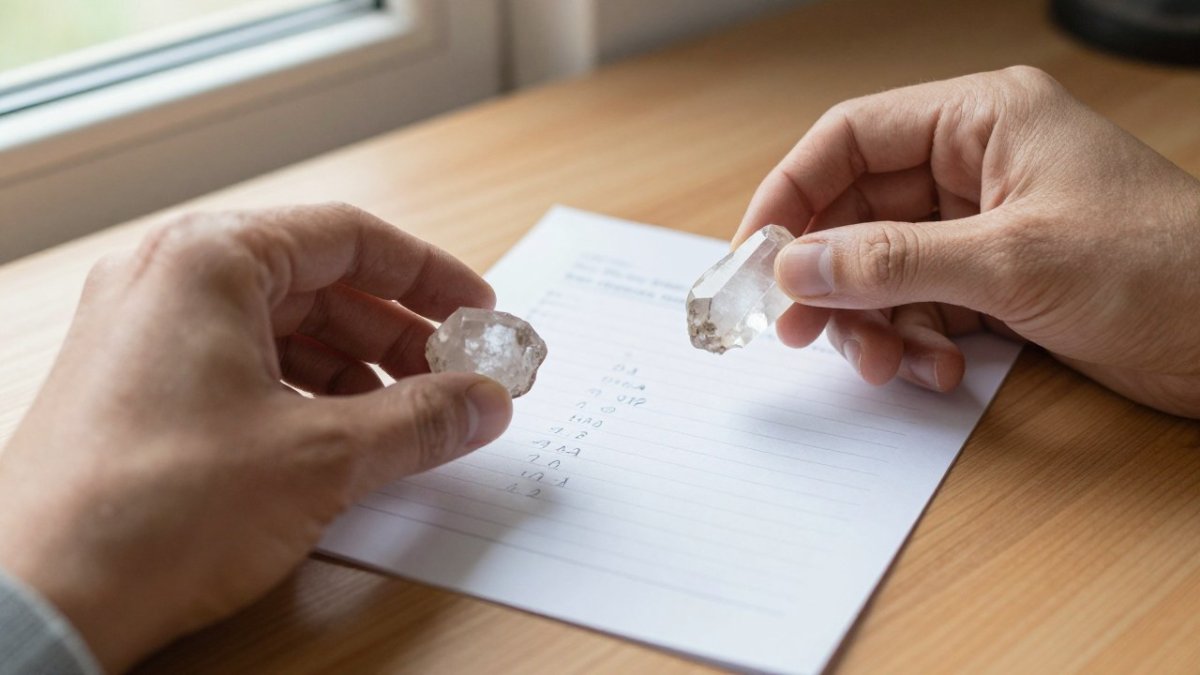
Here is a simple way to check a seller before you buy:
- Find the stated origin. Look for the country or specific mine on the product page. Shungite tiles, for example, list Russia as the origin. You can also see a fair trade example from this business in our Fair Trade Brass Individual Charms For Jewelry.
- Ask for documentation. Request supplier information, import records or a statement about the mining and cutting process.
- Check consistency. The origin should match the stone's appearance and the seller's other listings. Be cautious if the same stone is labeled from several places at once.
- Look at the full chain. A transparent seller can describe each step, from mine to processing to shipping.
- Compare the price to the claim. Very low prices for stones marketed as fairly sourced can mean the claim is hard to back up.
What different kinds of evidence actually prove
Most buyers treat any paperwork as proof of ethical sourcing. It isn't. Different documents establish different things, and knowing the difference keeps you from being reassured by the wrong paper.

- A supplier invoice shows that money changed hands between two businesses. It can confirm a seller bought from a named supplier, but it says nothing about where the stone was mined or how workers were treated.
- An origin declaration is a statement, usually from the seller or importer, naming a country or region. It is only as reliable as the person signing it, and it is rarely checked against the mine itself.
- A mine-to-market traceability record is stronger because it links a specific batch of stone to a specific extraction site and follows it through cutting and shipping. These records are uncommon for small crystals and more common for higher-value or industrial minerals.
A common pattern is that sellers mix these categories, presenting an invoice as if it were an origin record or a workshop certification as if it covered the whole chain.
The limits of traceability
Even careful sellers can't always trace a stone to the exact spot it was dug. Small-scale mining is often informal, stones are aggregated from many diggers at a single market, and batches get mixed before export.
That is not automatically a red flag. The useful question is whether the seller is clear about where their knowledge stops.
When you buy from us, you can see the origin listed on our Shungite tiles. For example, our Shungite Emf Cell Phone Tile Engraved 4 Seasons 30mm lists Russia as the origin, and our Shungite Laptop Tile Engraved Buddha 40mm does too.

Questions to Ask Crystal Sellers Before You Buy
Asking the right questions is the fastest way to tell a serious seller from a careless one. You don't need special knowledge. A good seller will answer plainly, and a vague answer tells you something too.
Ask these questions before you buy:
- Where was this stone mined, and can you name the country or mine?
- How did the stone reach you, and what handoffs happened along the way?
- Were the miners paid fairly, and what safety measures were in place?
Pay attention to the tone of the answers as well as the content. Sellers who are proud of their sourcing usually say so without being asked; sellers who deflect or repeat slogans without details are giving you useful information.
What a credible answer sounds like
The point of asking is not to collect a perfect answer but to judge whether the seller's knowledge is specific, consistent, and honest about its limits.
- A credible origin answer names a country and, where possible, a region or mine, and explains how the seller knows. "Brazil" alone is thin; "a licensed buyer in Minas Gerais who supplies our cutting workshop" is specific enough to check.
- A credible chain answer describes the actual handoffs, mine or aggregator, exporter, cutter, importer, seller, even if the seller only knows some of them. A seller who says "we buy from an importer who sources in India and cuts in Jaipur" is being more honest than one who claims direct mine access for a cheap stone.
- A credible labor answer avoids guarantees the seller cannot support. "We require our suppliers to confirm fair pay and no child labor, and we visit the cutting workshop" is a claim you can probe. "100% ethical, no exploitation" with no mechanism behind it is a slogan.
When the answers are weak or missing
Sometimes a seller cannot answer basic questions, and you have to decide what to do with that. A practical framework helps more than a vague sense of unease.
- Separate "can't" from "won't." A small seller may genuinely not know the mine behind a stone bought at a wholesale market. That is different from a seller who refuses to say where anything comes from. The first is a limit; the second is a choice.
- Decide what matters for this purchase. If you are buying a low-cost tumbled stone as a gift, a documented region may be enough. If you are paying a premium for a "fairly sourced" claim, the seller should be able to back that specific claim with specifics.
- Choose a better-documented alternative. If a seller cannot answer, ask whether they carry a stone from a source they can describe. Many sellers have one or two lines with clearer records and others with none. If you are looking for a specific stone, you can view our lapis lazuli stone of strength, wisdom and royalty and ask about its origin.
- Consider secondhand, vintage, or recycled stones. A stone that already exists does not require new extraction, so buying it sidesteps the mining question entirely. This is a legitimate ethical choice, not a consolation prize.
- Walk away when the basics fail. If a seller cannot name a country, describe any handoff, or explain what their documentation covers, you have learned enough. Declining to buy is a valid outcome of the checklist.
Keep notes on what each seller told you. If a claim turns out to be false, you'll have a record of what they promised, and you'll start to see which sellers answer consistently across listings.

Each question is paired with the answer that signals a credible seller, so you can scan what a good answer looks like.
| Question to ask | What a credible answer looks like | Red flag |
|---|---|---|
| Where was this stone mined? | Names a country, region or mine | Only says "ethically sourced" |
| How did the stone reach you? | Describes each handoff in the chain | Claims direct mine access for a cheap stone |
| Were miners paid fairly? | Names a mechanism, such as supplier requirements or visits | Offers a "100% ethical" slogan |
| What does your documentation cover? | Says what the document is and which step it covers | Treats any paperwork as proof |
| Can you share supplier details? | Provides a supplier name or document type | Deflects or repeats slogans |
Ethical Crystal Jewelry and Your Next Step With Superfly Wishes
Ethical sourcing is about more than a clean conscience. It is about knowing your piece has a story you can stand behind. At Superfly Wishes, we make crystal manifestation bracelets with a wish capsule for your intentions.
If you're ready to explore, browse our Shungite pieces and check their listed origins. Once you have your stone, learn how to cleanse manifestation crystals safely so it stays ready for your intentions.
Frequently Asked Questions
Can crystals be ethically sourced?
Yes, but ethical sourcing is a claim that has to be checked rather than assumed. A responsibly sourced stone should have a traceable origin, a seller who can name the country or mine, and documentation of how it moved through the supply chain. Where a seller cannot provide that, the honest answer is that the origin is unverified, and the buyer has to decide how much that matters to them.
Where can I buy ethically sourced healing crystals?
Look for sellers who publish their sourcing openly, name the country of origin for each stone, and explain how they know it. Small suppliers who work directly with miners or cutters often have the clearest chain of custody. Secondhand and recycled crystals avoid new mining altogether, though their history is harder to trace. Superfly Wishes lists the origin of its Shungite tiles, which is Russia.
What questions should I ask before buying a healing crystal?
Ask where the stone was mined, who cut and polished it, and whether the seller has documentation for the origin. Ask whether the supplier has direct relationships with miners or buys through intermediaries. Ask how the seller handles worker safety and fair pay, and what they would do if a supplier could not verify a claim. Vague answers are useful information in themselves.


